Understanding Cancer Stages: What Stage-0 to Stage-4 really means

doctor explaining cancer patient

One of the first things many people hear after a cancer diagnosis is a stage: Stage 1, Stage 2, or Stage 3 or 4. Those numbers often create fear because they sound like a score or a countdown. In reality, a cancer stage simply describes how far the cancer has grown or spread at the time it was found. It helps doctors choose treatment and talk about outlook, but it doesn't tell the whole story, and it definitely isn't a prediction carved in stone.

This guide walks through what each stage actually means, how doctors arrive at it, and why two people with the "same" stage can still have very different paths ahead.


A quick Primer: What TNM actually stands for 

Before the stage numbers make sense, it helps to know where they come from. Most solid cancers are staged using a system called TNM:

  • T (Tumor): how large the main tumor is and whether it has grown into nearby tissue

  • N (Nodes): whether the cancer has reached nearby lymph nodes, and how many

  • M (Metastasis): whether the cancer has spread to distant parts of the body

Doctors combine these three letters and numbers into an overall stage from 0 to 4. Once you know this, the rest of staging becomes much easier to follow because every stage below is really just a different combination of tumor size, node involvement, and spread.

NOTE: Healthcare providers might use other staging systems to diagnose different cancers.  


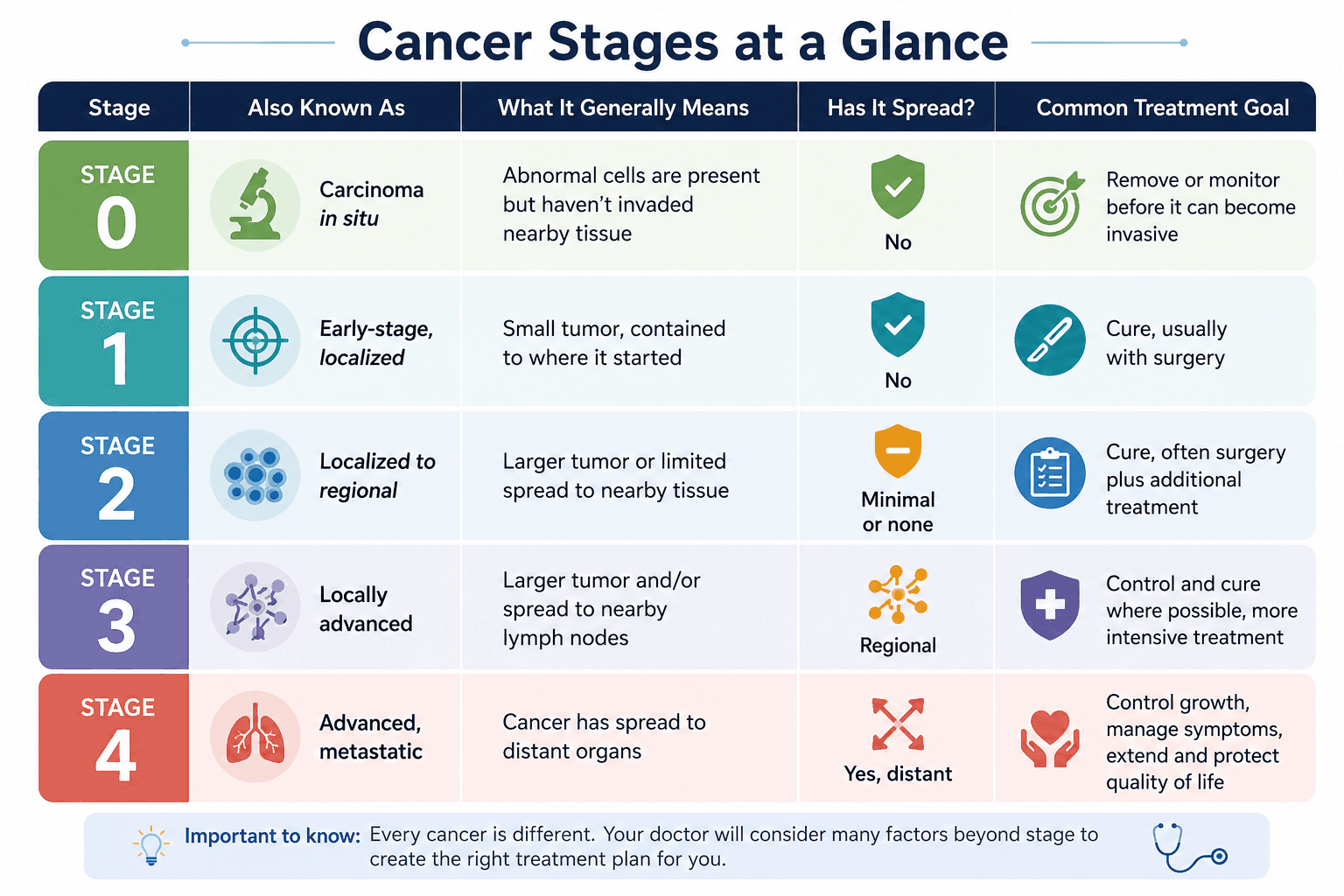
Cancer stages at a glance 

About Stage 0:

  • What it usually means: Abnormal cells are present, but they haven't grown beyond the layer of tissue where they started. This is sometimes called carcinoma in situ, meaning "in its original place."

  • Can it be cured? Yes, in most cases. Because the cells haven't invaded surrounding tissue, treatment at this stage is often very effective.

  • Has it spread? No.

  • Common treatments: Often surgical removal, sometimes combined with monitoring. Some cases are managed with close observation instead of immediate treatment, depending on the cancer type.

  • Questions to ask your doctor:
    Is this considered pre-cancerous or cancerous?
    What happens if it's simply monitored instead of treated right away?
    How often will I need follow-up scans or tests?


About Stage 1: 

  • What it usually means: The tumor is small and hasn't spread beyond the organ or tissue where it started.

  • Can it be cured? Generally yes. Stage 1 cancers tend to have the highest chance of successful treatment because they are still localized. For example, localized breast cancer has a 5-year relative survival rate of over 99%, while localized prostate cancer has a nearly 100%. 

  • Has it spread? No, it's localized (meaning the cancer is still contained within the organ or area where it started, with no signs of it reaching nearby lymph nodes or other parts of the body).

  • Common treatments: Surgery is often the main treatment, sometimes with additional therapy depending on the type of cancer.

  • Questions to ask your doctor:
    Is surgery alone enough, or will I need additional treatment?
    What is my expected recovery time?
    How often will I need follow-up screening after treatment?


About Stage 2:

  • What it usually means: The tumor is larger than in Stage 1, or it has grown slightly into nearby tissue. It may or may not involve nearby lymph nodes, depending on the cancer type.

  • Can it be cured? Often yes, though treatment is usually more involved than at Stage 1.

  • Has it spread? Minimally, if at all. It's still generally considered localized or early regional.

  • Common treatments: Surgery combined with chemotherapy, radiation, or both, depending on the specific cancer.

  • Questions to ask your doctor:
    Why is additional treatment (like chemo or radiation) recommended in my case?
    What are the side effects I should prepare for?
    How will we know if treatment is working?


About Stage 3:

  • What it usually means: The tumor is larger, and the cancer has typically spread to nearby lymph nodes or surrounding structures, but not to distant organs.

  • Can it be cured? Cure is still possible for many Stage 3 cancers, though treatment is usually more aggressive. Being in an advanced stage, treatment success depends heavily on the specific cancer type, the patient’s complete health status, and how well the tumor responds. 

  • Has it spread? Yes, regionally, meaning nearby but not to distant parts of the body.

  • Common treatments: A combination of surgery, chemotherapy, and radiation is common. Treatment plans are often more intensive and longer.

  • Questions to ask your doctor:
    What is the goal of treatment, cure or control?
    What does "regional spread" mean specifically in my case?
    Should I consider a clinical trial?


About Stage 4: 

  • What it usually means: The cancer has spread to distant parts of the body, away from where it started. This is often called metastatic cancer.

  • Can it be cured? Some Stage 4 cancers can still be treated effectively for extended periods, and a small number can be cured, but for many, the focus shifts to controlling growth and managing symptoms rather than eliminating the cancer entirely. This varies enormously by cancer type.

  • Has it spread? Yes, to distant organs or tissues.

  • Common treatments: Systemic treatments such as chemotherapy, targeted therapy, immunotherapy or hormone therapy, often combined with care focused on comfort and quality of life.

  • Questions to ask your doctor:
    What are realistic treatment goals at this stage?
    What support is available for managing symptoms and daily life?
    Are there clinical trials or newer therapies I should know about?


Cancer Stage vs Tumor Grade

These two terms get mixed up constantly, but they measure different things.

Stage describes how far the cancer has spread in terms of tumor size, lymph node involvement and distant spread.

While grade describes how different the cancer cells look from healthy cells under a microscope and gives doctors an idea of how quickly the cancer may grow and spread. A low-grade tumor tends to grow slowly and looks more like normal cells. A high-grade tumor looks more abnormal and tends to grow and spread faster.

You can have a low-stage but high-grade cancer, or the reverse. Both numbers matter and doctors often use them together to plan treatment.


How doctors determine cancer stage

Staging isn't a guess. Doctors combine several tools to arrive at an accurate stage:

  • Physical exam to check for lumps, swelling, or other signs

  • Imaging tests such as CT, MRI, or PET scans to see the tumor's size and location

  • A biopsy to examine cancer cells under a microscope and confirm the diagnosis

  • Lab tests including blood work that can point to how advanced the disease is

  • Surgical staging, in some cases, where lymph nodes are checked directly during surgery

All of this is measured against a standardized system, most often the TNM framework described above, so that staging means roughly the same thing across hospitals and countries.


Common myths about cancer stages

Staging gets misunderstood a lot, partly because the word "stage" also gets used loosely in everyday conversation. Here are some of the most common misconceptions worth clearing up. 

Myth: Stage 4 always means there is no hope

Not true. Many Stage 4 cancers can be treated effectively for months or years, and treatment options continue to expand. Outlook depends heavily on cancer type, biology, and how well it responds to treatment.

Myth: A higher stage always means a bigger tumor

Not necessarily. Staging factors in lymph node involvement and distant spread, not just tumor size. A smaller tumor that has spread to lymph nodes can be staged higher than a larger tumor that hasn't spread at all.

Myth: All cancers have a Stage 0

False. Not every cancer type uses a Stage 0 category, and some cancers, like most leukemias, aren't staged using the 0 to 4 system at all.

Myth: Stage tells you exactly how long someone will live

Stage is one factor among many. It's used to guide treatment and give a general sense of outlook, not to predict an individual timeline.

Myth: Once treatment ends, your stage resets or goes away

Your original stage stays on your medical record as a permanent reference point, even after successful treatment. It doesn't reset to "Stage 0" or disappear once you're in remission.

Myth: Everyone with the same stage gets the same treatment. 

Not true. Two people with an identical stage can be given different treatment plans based on tumor biology, genetic markers, overall health, age, and personal preferences. Stage is a starting point for the conversation, not a fixed protocol.


Why people with the same stage can have different outcomes

Two people diagnosed with "Stage 2" of the same cancer can have very different journeys. That's because the stage is only one piece of the picture. Other factors that shape outcomes include:

  • Tumor biology, such as specific genetic mutations or biomarkers (for example, hormone receptor or HER2 status in breast cancer)

  • Tumor grade, how fast the cells are likely to grow

  • Overall health and age, which affect how well someone can tolerate treatment

  • How the cancer responds to treatment, which isn't always predictable in advance

  • Access to timely, high-quality care

This is part of why oncologists resist giving firm timelines based on stage alone. Broadly speaking, cancer caught while still localized tends to have far better outcomes than cancer found after it has spread. 

Across many cancer types combined, five-year relative survival is around 91.8% when the disease is localized at diagnosis, compared with about 15.1% when it has spread to distant parts of the body. That gap is exactly why early detection matters so much, and also why stage alone never tells the full story for an individual.


What happens if cancer comes back?

A question many people have later on, does the stage change if cancer returns after treatment? Generally, no. The original stage given at diagnosis stays on your medical record as-is, mainly so doctors and researchers can track outcomes consistently over time. If cancer returns, doctors describe it separately as a recurrence, and sometimes note it with an "r" before the stage (for example, rStage 3) to distinguish it from the original diagnosis. Recurrent cancer is evaluated and treated based on where it has come back and how far it has spread at that point, not the original stage number.


Questions to ask your doctor after learning your stage

It's easy to blank out in the room after hearing a stage, and think of the right questions only once you're home. Keeping a short list on hand, whether on your phone or on paper, can make the conversation feel less rushed and more useful. 

  • What stage is my cancer, and what does that mean specifically for my type of cancer?

  • What factors, besides stage, are being considered in my treatment plan?

  • What is the goal of treatment: cure, control, or comfort?

  • Are there clinical trials that might be relevant for me?

  • What symptoms or changes should prompt me to call you right away?

  • Who else should be part of my care team?


What should you do after learning your stage?

Take your time before making decisions. A stage is important information, but it's rarely the whole picture, and you don't have to process it or act on it immediately.

A few grounding steps that tend to help:

  • Ask for things to be explained in plain language: It's fair to ask your doctor to walk through your specific TNM findings and what they mean for you.

  • Consider a second opinion: Especially for less common cancers or before major treatment decisions.

  • Avoid comparing your case to stories you find online: A quick Google search can turn up someone else's story with the same stage, but it may involve a different cancer subtype, different biology, or a different response to treatment, so it rarely predicts what your own path will look like. 

  • Lean on your support system: Lean on anyone whether that's family, friends, a social worker, or a patient support group connected to your treatment center.


If you're further along in follow-up care and notice new or changing symptoms between appointments, a tool like Clyvera's symptom checker can help you get organized before a call with your doctor. It won't tell you what's going on, but it can help you put vague feelings into clearer language, which often makes those conversations more productive.

Understanding your stage is a starting point for conversations with your care team, not a final verdict. The most useful next step is almost always the same one: bring your questions to your doctor and ask them to explain what your specific numbers mean for you.


Conclusion

A cancer stage is a snapshot, not a sentence!

It tells your care team how far the disease has grown or spread at diagnosis, so they can plan the right treatment and track progress over time, but it says nothing about your individual biology, how you'll respond to treatment, or what your life will look like six months or five years from now. The most reliable way to understand what your stage means for you is a direct conversation with your doctor, backed by the questions above and a support system you trust. 

One of the first things many people hear after a cancer diagnosis is a stage: Stage 1, Stage 2, or Stage 3 or 4. Those numbers often create fear because they sound like a score or a countdown. In reality, a cancer stage simply describes how far the cancer has grown or spread at the time it was found. It helps doctors choose treatment and talk about outlook, but it doesn't tell the whole story, and it definitely isn't a prediction carved in stone.

This guide walks through what each stage actually means, how doctors arrive at it, and why two people with the "same" stage can still have very different paths ahead.


A quick Primer: What TNM actually stands for 

Before the stage numbers make sense, it helps to know where they come from. Most solid cancers are staged using a system called TNM:

  • T (Tumor): how large the main tumor is and whether it has grown into nearby tissue

  • N (Nodes): whether the cancer has reached nearby lymph nodes, and how many

  • M (Metastasis): whether the cancer has spread to distant parts of the body

Doctors combine these three letters and numbers into an overall stage from 0 to 4. Once you know this, the rest of staging becomes much easier to follow because every stage below is really just a different combination of tumor size, node involvement, and spread.

NOTE: Healthcare providers might use other staging systems to diagnose different cancers.  


Cancer stages at a glance 


About Stage 0:

  • What it usually means: Abnormal cells are present, but they haven't grown beyond the layer of tissue where they started. This is sometimes called carcinoma in situ, meaning "in its original place."

  • Can it be cured? Yes, in most cases. Because the cells haven't invaded surrounding tissue, treatment at this stage is often very effective.

  • Has it spread? No.

  • Common treatments: Often surgical removal, sometimes combined with monitoring. Some cases are managed with close observation instead of immediate treatment, depending on the cancer type.

  • Questions to ask your doctor:
    Is this considered pre-cancerous or cancerous?
    What happens if it's simply monitored instead of treated right away?
    How often will I need follow-up scans or tests?


About Stage 1: 

  • What it usually means: The tumor is small and hasn't spread beyond the organ or tissue where it started.

  • Can it be cured? Generally yes. Stage 1 cancers tend to have the highest chance of successful treatment because they are still localized. For example, localized breast cancer has a 5-year relative survival rate of over 99%, while localized prostate cancer has a nearly 100%. 

  • Has it spread? No, it's localized (meaning the cancer is still contained within the organ or area where it started, with no signs of it reaching nearby lymph nodes or other parts of the body).

  • Common treatments: Surgery is often the main treatment, sometimes with additional therapy depending on the type of cancer.

  • Questions to ask your doctor:
    Is surgery alone enough, or will I need additional treatment?
    What is my expected recovery time?
    How often will I need follow-up screening after treatment?


About Stage 2:

  • What it usually means: The tumor is larger than in Stage 1, or it has grown slightly into nearby tissue. It may or may not involve nearby lymph nodes, depending on the cancer type.

  • Can it be cured? Often yes, though treatment is usually more involved than at Stage 1.

  • Has it spread? Minimally, if at all. It's still generally considered localized or early regional.

  • Common treatments: Surgery combined with chemotherapy, radiation, or both, depending on the specific cancer.

  • Questions to ask your doctor:
    Why is additional treatment (like chemo or radiation) recommended in my case?
    What are the side effects I should prepare for?
    How will we know if treatment is working?


About Stage 3:

  • What it usually means: The tumor is larger, and the cancer has typically spread to nearby lymph nodes or surrounding structures, but not to distant organs.

  • Can it be cured? Cure is still possible for many Stage 3 cancers, though treatment is usually more aggressive. Being in an advanced stage, treatment success depends heavily on the specific cancer type, the patient’s complete health status, and how well the tumor responds. 

  • Has it spread? Yes, regionally, meaning nearby but not to distant parts of the body.

  • Common treatments: A combination of surgery, chemotherapy, and radiation is common. Treatment plans are often more intensive and longer.

  • Questions to ask your doctor:
    What is the goal of treatment, cure or control?
    What does "regional spread" mean specifically in my case?
    Should I consider a clinical trial?


About Stage 4: 

  • What it usually means: The cancer has spread to distant parts of the body, away from where it started. This is often called metastatic cancer.

  • Can it be cured? Some Stage 4 cancers can still be treated effectively for extended periods, and a small number can be cured, but for many, the focus shifts to controlling growth and managing symptoms rather than eliminating the cancer entirely. This varies enormously by cancer type.

  • Has it spread? Yes, to distant organs or tissues.

  • Common treatments: Systemic treatments such as chemotherapy, targeted therapy, immunotherapy or hormone therapy, often combined with care focused on comfort and quality of life.

  • Questions to ask your doctor:
    What are realistic treatment goals at this stage?
    What support is available for managing symptoms and daily life?
    Are there clinical trials or newer therapies I should know about?


Cancer Stage vs Tumor Grade

These two terms get mixed up constantly, but they measure different things.

Stage describes how far the cancer has spread in terms of tumor size, lymph node involvement and distant spread.

While grade describes how different the cancer cells look from healthy cells under a microscope and gives doctors an idea of how quickly the cancer may grow and spread. A low-grade tumor tends to grow slowly and looks more like normal cells. A high-grade tumor looks more abnormal and tends to grow and spread faster.

You can have a low-stage but high-grade cancer, or the reverse. Both numbers matter and doctors often use them together to plan treatment.


How doctors determine cancer stage

Staging isn't a guess. Doctors combine several tools to arrive at an accurate stage:

  • Physical exam to check for lumps, swelling, or other signs

  • Imaging tests such as CT, MRI, or PET scans to see the tumor's size and location

  • A biopsy to examine cancer cells under a microscope and confirm the diagnosis

  • Lab tests including blood work that can point to how advanced the disease is

  • Surgical staging, in some cases, where lymph nodes are checked directly during surgery

All of this is measured against a standardized system, most often the TNM framework described above, so that staging means roughly the same thing across hospitals and countries.


Common myths about cancer stages

Staging gets misunderstood a lot, partly because the word "stage" also gets used loosely in everyday conversation. Here are some of the most common misconceptions worth clearing up. 

Myth: Stage 4 always means there is no hope

Not true. Many Stage 4 cancers can be treated effectively for months or years, and treatment options continue to expand. Outlook depends heavily on cancer type, biology, and how well it responds to treatment.

Myth: A higher stage always means a bigger tumor

Not necessarily. Staging factors in lymph node involvement and distant spread, not just tumor size. A smaller tumor that has spread to lymph nodes can be staged higher than a larger tumor that hasn't spread at all.

Myth: All cancers have a Stage 0

False. Not every cancer type uses a Stage 0 category, and some cancers, like most leukemias, aren't staged using the 0 to 4 system at all.

Myth: Stage tells you exactly how long someone will live

Stage is one factor among many. It's used to guide treatment and give a general sense of outlook, not to predict an individual timeline.

Myth: Once treatment ends, your stage resets or goes away

Your original stage stays on your medical record as a permanent reference point, even after successful treatment. It doesn't reset to "Stage 0" or disappear once you're in remission.

Myth: Everyone with the same stage gets the same treatment. 

Not true. Two people with an identical stage can be given different treatment plans based on tumor biology, genetic markers, overall health, age, and personal preferences. Stage is a starting point for the conversation, not a fixed protocol.


Why people with the same stage can have different outcomes

Two people diagnosed with "Stage 2" of the same cancer can have very different journeys. That's because the stage is only one piece of the picture. Other factors that shape outcomes include:

  • Tumor biology, such as specific genetic mutations or biomarkers (for example, hormone receptor or HER2 status in breast cancer)

  • Tumor grade, how fast the cells are likely to grow

  • Overall health and age, which affect how well someone can tolerate treatment

  • How the cancer responds to treatment, which isn't always predictable in advance

  • Access to timely, high-quality care

This is part of why oncologists resist giving firm timelines based on stage alone. Broadly speaking, cancer caught while still localized tends to have far better outcomes than cancer found after it has spread. 

Across many cancer types combined, five-year relative survival is around 91.8% when the disease is localized at diagnosis, compared with about 15.1% when it has spread to distant parts of the body. That gap is exactly why early detection matters so much, and also why stage alone never tells the full story for an individual.


What happens if cancer comes back?

A question many people have later on, does the stage change if cancer returns after treatment? Generally, no. The original stage given at diagnosis stays on your medical record as-is, mainly so doctors and researchers can track outcomes consistently over time. If cancer returns, doctors describe it separately as a recurrence, and sometimes note it with an "r" before the stage (for example, rStage 3) to distinguish it from the original diagnosis. Recurrent cancer is evaluated and treated based on where it has come back and how far it has spread at that point, not the original stage number.


Questions to ask your doctor after learning your stage

It's easy to blank out in the room after hearing a stage, and think of the right questions only once you're home. Keeping a short list on hand, whether on your phone or on paper, can make the conversation feel less rushed and more useful. 

  • What stage is my cancer, and what does that mean specifically for my type of cancer?

  • What factors, besides stage, are being considered in my treatment plan?

  • What is the goal of treatment: cure, control, or comfort?

  • Are there clinical trials that might be relevant for me?

  • What symptoms or changes should prompt me to call you right away?

  • Who else should be part of my care team?


What should you do after learning your stage?

Take your time before making decisions. A stage is important information, but it's rarely the whole picture, and you don't have to process it or act on it immediately.

A few grounding steps that tend to help:

  • Ask for things to be explained in plain language: It's fair to ask your doctor to walk through your specific TNM findings and what they mean for you.

  • Consider a second opinion: Especially for less common cancers or before major treatment decisions.

  • Avoid comparing your case to stories you find online: A quick Google search can turn up someone else's story with the same stage, but it may involve a different cancer subtype, different biology, or a different response to treatment, so it rarely predicts what your own path will look like. 

  • Lean on your support system: Lean on anyone whether that's family, friends, a social worker, or a patient support group connected to your treatment center.


If you're further along in follow-up care and notice new or changing symptoms between appointments, a tool like Clyvera's symptom checker can help you get organized before a call with your doctor. It won't tell you what's going on, but it can help you put vague feelings into clearer language, which often makes those conversations more productive.

Understanding your stage is a starting point for conversations with your care team, not a final verdict. The most useful next step is almost always the same one: bring your questions to your doctor and ask them to explain what your specific numbers mean for you.


Conclusion

A cancer stage is a snapshot, not a sentence!

It tells your care team how far the disease has grown or spread at diagnosis, so they can plan the right treatment and track progress over time, but it says nothing about your individual biology, how you'll respond to treatment, or what your life will look like six months or five years from now. The most reliable way to understand what your stage means for you is a direct conversation with your doctor, backed by the questions above and a support system you trust. 

Clyvera app Logo

Your smart health journey begins here

Take the first step towards better health and peace of mind—because you deserve it.

Mobile screenshot showing clyvera app landing page
Icon of HIPAA complaince
Icon of GDPR complaince

Join thousands of users embracing smarter Cancer-care with Clyvera.

©2025 Docbud Corp - All Rights Reserved.

Clyvera app Logo

Your smart health journey begins here

Take the first step towards better health and peace of mind—because you deserve it.

Mobile screenshot showing clyvera app landing page
Icon of HIPAA complaince
Icon of GDPR complaince

Join thousands of users embracing smarter Cancer-care with Clyvera.

©2025 Docbud Corp - All Rights Reserved.

Clyvera app Logo

Your smart health journey begins here

Take the first step towards better health and peace of mind—because you deserve it.

Mobile screenshot showing clyvera app landing page
Icon of HIPAA complaince
Icon of GDPR complaince

Join thousands of users embracing smarter Cancer-care with Clyvera.

©2025 Docbud Corp - All Rights Reserved.